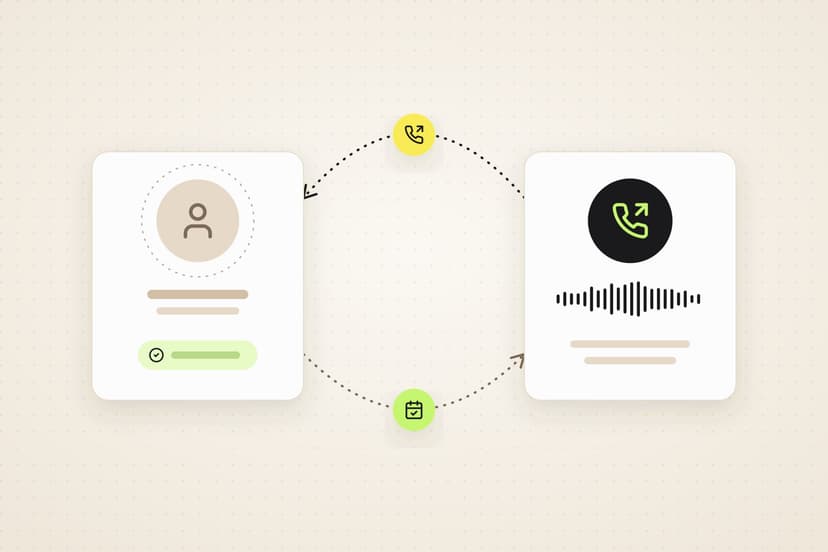
In short: With AI batch calling, an AI voice agent calls a list of phone numbers and holds a real conversation with everyone who picks up. It pays off most for calls your customers expect: appointment reminders, missing documents, delivery and payment information, callbacks on enquiries. These calls are not marketing and do not need marketing consent. Cold calling consumers stays illegal in Germany, with or without AI. In EchoCall a campaign takes up to 10,000 recipients, and you pay per minute of conversation, about €0.30 a minute.
What batch calling is, and what it is not
Three things are often mixed up:
| Method | What happens | What the person called experiences |
|---|---|---|
| Robocall with a recorded message | a machine dials and plays a recording | an announcement, no way to ask anything |
| Predictive dialer in a call center | software dials ahead, a person takes over once someone answers | often a pause, then a person |
| AI batch calling | an AI agent dials every number on the list and holds the conversation | a conversation with questions and an outcome |
The difference from a recorded message: the person can answer, ask, reschedule. The difference from a predictive dialer: no human is waiting for the next call, and nobody ends up on a silent line.
Which campaigns pay off and are allowed
Whether a campaign is legally straightforward almost always comes down to one question: is the call marketing? In Germany, § 7 of the Unfair Competition Act (UWG) regulates marketing calls. [1] Calls that carry out an existing contract or a request from the customer are not marketing.
| Campaign | Is it marketing? | Assessment |
|---|---|---|
| Callback on an enquiry (form, voicemail, chat) | no, as long as it stays on the enquiry | allowed |
| Appointment confirmation and reminder | no, performance of a contract | allowed |
| Requesting missing documents | no, performance of a contract | allowed |
| Delivery and payment information, friendly reminder | no, performance of a contract | allowed |
| Reminder for an event someone registered for | no, as long as no new offers are added | allowed |
| Customer satisfaction survey | German courts regularly treat it as marketing | only with consent |
| Winning back former private customers | yes | only with express consent |
| Cold calling consumers | yes | prohibited |
| First contact with businesses by AI | yes | consent recommended, otherwise risk of claims |
The last row is the tricky one. No German court has yet decided whether an AI agent counts as an "automatic calling machine", which needs express consent even in B2B. The full reasoning with statutory text, fines and the rules in Austria, Switzerland, the UK and the US is in our guide to AI cold calling.
A service call only stays a service call while it stays on topic. Offer an add-on during the appointment reminder and it becomes a marketing call. That belongs in the prompt: the agent offers nothing nobody asked for.
Five campaigns that pay off in practice
- Reminder the day before. Medical practices, garages, beauty salons, public offices. The agent confirms the appointment, moves it in the calendar on request or releases it. A freed slot can be filled the same day. More for medical practices.
- Missing documents. Tax advisers, insurance brokers, property managers. The agent says what is missing, by when and how to send it. That replaces the callback list that otherwise stays untouched on Friday afternoon. See law and tax firms.
- Callback on enquiries. Someone who fills in a form in the evening gets called first thing the next morning, not when sales finds the time. How pre-qualification works is covered in lead qualification with AI voice agents.
- Friendly payment reminder. The agent mentions an open invoice, the amount and the due date, and takes note if someone has questions or wants to pay in instalments. It does not threaten and does not collect. That stays with you.
- Win-back with consent. Customers who have expressly agreed to be contacted can be approached directly. How to collect that consent properly is in customer win-back with AI.
How to set up a campaign in EchoCall
- Create a dedicated agent for the campaign. One agent, one goal. The prompt says why the call is made, what the outcome should be and when the call ends politely. The first sentence names your business, the reason for the call and that an AI is speaking.
- Pick the caller number. The campaign calls from a number in your EchoHub. Use one people can call back on.
- Upload the list. As a CSV file with phone number and name, or as a manual list, up to 10,000 recipients per campaign. With the API you create campaigns straight from your own system.
- Clean the list before uploading it. Remove duplicates, remove objections, keep only contacts the reason applies to. EchoCall does not check against a suppression list automatically. That is your job, and it matters.
- Set the start time. Now or scheduled. Germany has no statutory calling hours, but nobody enjoys an appointment reminder at 8:30 pm. Split large lists into several campaigns with their own start times.
- Start small, then review. First 20 numbers, read the transcripts, sharpen the prompt. The campaign view shows status, successful calls, cost and call history. Running or scheduled campaigns can be cancelled at any time.
How AI outbound agents handle objections
A voice agent responds to objections the way you define in the prompt. It has no sales talent of its own and should not pretend to. A proven approach is to store a fixed response for the most common objections:
| Objection | Good response from the agent |
|---|---|
| "I don't have time right now." | Offer a better time or book an appointment in the calendar. |
| "Where did you get my number?" | Name the source, as you have stored it in the prompt. |
| "Send me that by email." | Confirm the email address and send an email via Gmail or SMTP. |
| "I want to speak to a person." | Transfer to a phone number on your team or promise a callback. |
| "Not interested." | End politely. No second attempt. |
| "Don't call me again." | Confirm, end the call and pass the objection on to your system. |
Two rules matter more than any wording. First: no means no. An agent that pushes back annoys people faster than a member of staff, because everyone senses a script running. Second: the agent promises nothing that is not in the prompt, so no discounts, no deadlines, no special terms.
Some calls end up on voicemail. With voicemail detection, the agent can recognise whether a person or a voicemail answers. Test how this behaves with your contacts before you start a large list.
When the agent hands over to a person
A good agent knows its limits, but only if you tell it what they are. EchoCall does not provide automatic emotion detection that escalates on its own. You define in the prompt when the agent hands over:
- The person called explicitly asks for a human.
- It is about a complaint, damage or a legal question.
- It is about an order above a limit you set.
- The agent cannot find the answer in its knowledge.
On the phone the agent then connects to a phone number on your team. For times when nobody is available, you specify that it takes a callback request instead and passes it on. Every call is then available as a transcript in the dashboard.
What a campaign costs: an example
You pay for minutes of conversation from your voice plan. In every plan a minute comes to about €0.30. [2] Inbound and outbound calls come from the same plan.
| Assumption | Value |
|---|---|
| Recipients | 400 appointment reminders |
| Average call length | 1.5 minutes |
| Minutes of conversation | 600 |
| Cost at about €0.30 per minute | about €180 |
How long a call takes depends on your prompt. A reminder asking "does the time still work?" takes under a minute. A callback with pre-qualification more like three to five.
On paper a person's minute of conversation is hardly more expensive: a German call center agent costs the employer about €0.35 per working minute, as worked out in our AI voice agent statistics. The difference is elsewhere. A person dials one after another, waits for the ring, hits voicemail and documents afterwards. 400 calls take one person several working days. A campaign calls several numbers at once, and every conversation lands in the dashboard as a transcript.
Rules that apply to every campaign
- AI disclosure: Since 2 August 2026 people in the EU must learn that they are talking to an AI (Article 50 EU AI Act). [3] It belongs in the first sentence.
- Show your number: In Germany, anyone calling for marketing must not hide their number, with fines up to €300,000. [4] For service calls too, a visible number people can call back builds trust.
- Data protection: You need a legal basis under Article 6 GDPR, for service calls usually performance of a contract. Anyone who objects goes on your suppression list. [5]
- Where the number comes from: If you did not get the number from the person directly, you must tell them where your data comes from at the latest at the first contact (Article 14 GDPR). [5]
- Document consent: For telephone marketing to consumers in Germany, § 7a UWG requires you to document the consent and keep the proof for five years. [7]
- Data processing agreement: Your provider processes the calls on your behalf. You need a data processing agreement for that.
- Recording: Audio recording can be switched off per agent. If you record, the agent says so at the start.
- Calls to the US: Calling hours of 8 am to 9 pm in the recipient's local time apply, plus strict consent rules for artificial voices. [6]
Where the limits are
- Voicemail and no answer. Not everyone picks up. For important matters, plan a second channel such as email or text from your own system.
- Sensitive conversations. Cancellations, reminders with legal consequences, medical results: these belong with a person.
- Bad lists. Wrong numbers, outdated names, no reason for the call. The best AI cannot save a bad list.
- Selling without consent. See the table above. AI does not make a prohibited call legal. It only makes it faster.
Frequently asked questions about AI batch calling
Is AI batch calling legal?
In Germany, for calls that carry out a contract or a request, yes: appointment reminders, missing documents, delivery and payment information, callbacks. These are not marketing calls. Marketing calls to consumers need prior express consent, with AI too. For the UK and US rules, see our guide to AI cold calling.
How many recipients can a campaign have?
In EchoCall up to 10,000 recipients per campaign. Split larger lists into several campaigns, which makes sense anyway because of start times.
Does EchoCall check automatically whether I may call someone?
No. EchoCall does not check consent and does not compare against a suppression list. You upload only contacts the reason applies to and keep objections in your own system.
What does an AI call campaign cost?
You pay for minutes of conversation, about €0.30 a minute from your voice plan. 400 appointment reminders at an average of one and a half minutes come to about €180. There is no setup fee.
Can the agent handle questions and objections?
Yes. The agent holds a conversation, not a rigid script. It answers questions from its knowledge base, moves appointments in the calendar and transfers to a person if you have set up a number for that. For the most common objections you set a fixed response in the prompt. On "not interested" or "don't call me again" it ends the call politely and passes the objection on.
When does the agent hand over to a person?
When you define it in the prompt, for example on explicit request, for complaints, for larger orders or when it does not know the answer. On the phone it then connects to a phone number on your team. EchoCall has no automatic emotion detection.
Can I start campaigns from my CRM or software?
Yes, with the EchoCall API. You create a campaign with its recipients, start it, check the status of each call or cancel it. Without a developer, use the CSV upload in the dashboard.
What is the difference between inbound and outbound calls?
Inbound calls are calls that come in to you, such as customer questions or appointment requests. Outbound calls are calls your company makes, such as appointment reminders, callbacks or offers. For outbound, competition law also applies as soon as the call is advertising. How an agent answers incoming calls is covered in the AI phone agent guide.
Sources
- § 7 UWG (German Unfair Competition Act), unacceptable nuisance: gesetze-im-internet.de, § 7 UWG
- EchoCall pricing: echocall.de/en/pricing
- Regulation (EU) 2024/1689 (AI Act), Article 50: eur-lex.europa.eu
- Bundesnetzagentur, unlawful telephone advertising (number suppression under § 15(2) TDDDG, fines up to €300,000): bundesnetzagentur.de
- Regulation (EU) 2016/679 (GDPR), Articles 6, 14 and 21: eur-lex.europa.eu
- 47 CFR § 64.1200, Delivery restrictions (calling hours, consent): law.cornell.edu
- § 7a UWG (German Unfair Competition Act), consent to telephone advertising: gesetze-im-internet.de, § 7a UWG
All links were checked on 6 October 2026, source 7 on 21 October 2026. This article is not legal advice.
Revised in October 2026: we removed claims we could not source and merged our earlier post "Automating Inbound and Outbound Calls with AI" into this one.