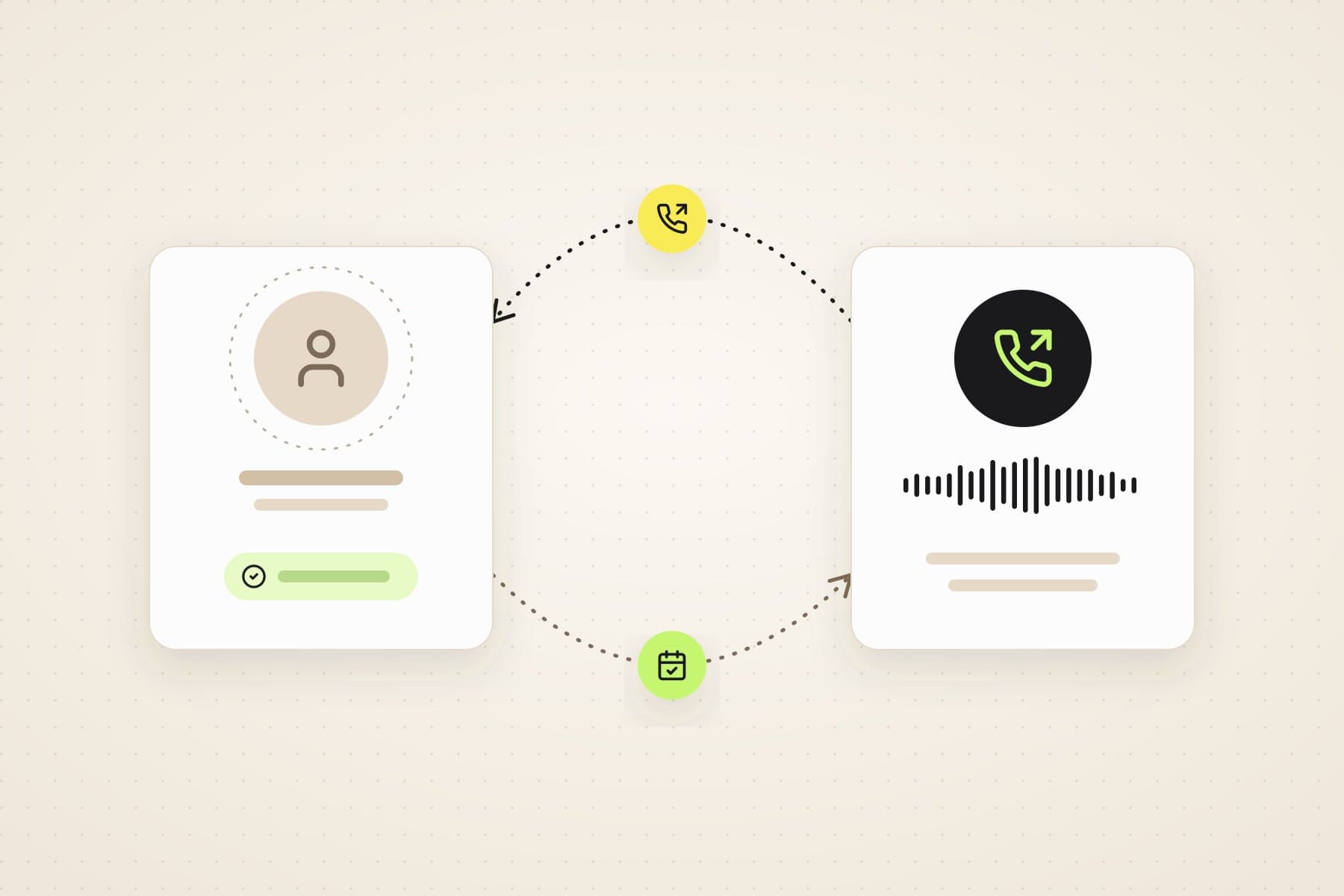
In short: A call meant to win back former customers is advertising. Under German law you need prior express consent from consumers for it, and unlike email there is no exception for existing customers on the phone. An AI voice agent therefore delivers most where the customer calls you, for example to cancel, and with contacts who have agreed to calls. When someone cancels, the agent may ask for the reason and offer an alternative, but it must not make cancelling harder.
We rewrote this post in October 2026. The old version promised three times as many reactivations as email in its title, quoted open rates from a Salesforce report, a conversation rate of 45 to 60 % and a case study with 500 customers. We found no source for any of these figures. It also claimed that EchoCall checks consents automatically and re-books returning customers by itself. Neither is true. And it recommended calling former gym and mobile phone customers without saying that consent is required. All of that has been corrected.
Why keeping customers pays
The Harvard Business Review summarises the research like this: depending on the study and the industry, acquiring a new customer is five to 25 times more expensive than retaining an existing one. It also cites Frederick Reichheld of Bain & Company: increasing customer retention rates by 5 % increases profits by 25 to 95 %. [1]
These figures are about keeping existing customers, not winning back former ones. We did not find a reliable study comparing win-back by phone and by email. That is why "3× more reactivations" is no longer in the title. The direction is still clear: a customer who stays is cheaper than one you have to win anew. The best moment for a conversation is when they want to cancel.
Win-back on the phone: four situations, four legal positions
In Germany, advertising calls are governed by Section 7 of the Unfair Competition Act (UWG). [2] The full reasoning is in our guide AI Cold Calling in 2026. For win-back, four situations matter:
| Situation | Advertising? | What you need |
|---|---|---|
| Customer calls to cancel | no, they call you | name the way to cancel, do not obstruct it |
| You call about a contract matter, such as an open payment | no, as long as it stays with that matter | a GDPR legal basis, usually the contract |
| You call former or inactive customers with an offer | yes | consumers: prior express consent |
| Survey after cancellation asking why the customer left | courts regularly treat it as advertising | consent |
No existing-customer exception on the phone
Many people confuse this with email. Section 7(3) UWG contains an exception for email advertising to your own customers, under narrow conditions. This exception applies only to electronic mail. [2] For a call to a former private customer you need prior express consent, even if they were with you for ten years.
Business customers
With business customers, presumed consent is enough for a call by a person. An ongoing or recently ended business relationship can support that. Whether an AI agent counts as an automatic calling machine, which requires express consent even in B2B, has not yet been decided by any court. We advise treating AI advertising calls as if it does. [2]
Service quickly turns into advertising
A call about a failed payment is a service call. If the agent offers a different plan in the same call, it becomes an advertising call. So write explicitly into a service agent's prompt that it makes no offers.
Cancellation calls: retention offer yes, obstacles no
When a customer calls to cancel, it is the best opportunity for a conversation, and legally the simplest. Two rules draw the line:
- No obstacles. Under Section 4a UWG, it is an aggressive commercial practice to try to stop customers from exercising their contractual rights with burdensome or disproportionate obstacles, explicitly including the right to terminate the contract. [3]
- The cancellation button stays. Anyone who concludes contracts with consumers via a website must offer a cancellation button under Section 312k of the German Civil Code (BGB). [4] An agent on the phone does not replace this route.
An agent that asks for the reason and offers an alternative is compatible with this. An agent that pushes back three times, refuses to accept the cancellation or puts the customer off is not. A conversation flow that keeps the two apart:
- Ask for the reason. "May I ask why you would like to cancel?"
- Offer one alternative if it fits. Pausing, a smaller plan, an appointment with your team to solve a problem.
- On a no, name the route at once. For example: "Understood. The easiest way to cancel is the button in your customer account." No second offer.
- Pass on the result. Reason, offer and answer as a note in HubSpot, as a task in Salesforce or as a message to your team in Slack or Microsoft Teams.
An important expectation: the agent does not change the contract itself. It records the result and passes it on, and your team carries it out. If you want to automate that, you need your own connection, for example via a webhook or the REST interface described in The EchoHub API Guide 2026.
Churn prevention calls to contacts who have consented
If customers have agreed to advertising calls, you can also have an agent call them. In EchoCall you set up a campaign for this: a list as a CSV file or entered by hand, up to 10,000 recipients, started at once or at a scheduled time. How to set it up is described in our post AI Batch Calling 2026: How to Run AI Outbound Call Campaigns.
Three points on this:
- EchoCall does not check consents and does not match against a do-not-call list. You upload only contacts for whom documented consent exists, and you maintain objections in your own system.
- One offer for the whole list. Write the prompt and the offer so that they fit every contact on the list. Split the list by plan or cancellation reason rather than building an offer that fits nobody exactly.
- Record objections at once. If someone says "please do not call me again", the agent must understand and pass it on. Once someone objects to direct marketing, you may no longer use their data for it (Article 21(3) GDPR). [5]
For every call, Article 50 of the AI Act has also applied since 2 August 2026: the people called must be told that they are talking to an AI. [6] With EchoCall you write this notice into the agent's first message.
How to obtain consent for win-back calls
Consent is the bottleneck of any win-back by phone. Obtain it while the customer is still a customer:
- A separate tick box, not hidden in the terms and not pre-ticked.
- Be specific: who calls and for what purpose, for example "offers on our plans, including after the contract ends".
- Name the channel: telephone, and that an AI assistant may call.
- Document it: under Section 7a UWG you must document consumers' consent to telephone advertising and keep the record for five years. [7]
- Make withdrawal easy: by email, in the customer account or directly in the conversation with the agent.
Whether an existing consent covers AI calls depends on its wording. If in doubt, have it checked.
What does it cost? Two worked examples with assumptions
Both examples refer to a provider with monthly subscriptions. All figures are assumptions, replace them with your own.
Example A: answering cancellation calls
- 60 cancellation calls a month, 5 minutes with the agent on average, so 300 minutes.
- The 500-minute plan costs €150 a month. [8] Phone number and telephony come on top, they are not included in EchoCall's plan prices.
- One caller in ten accepts the alternative, so 6 customers.
- Each stays 6 months longer on average and brings €20 of contribution margin a month, so €120.
- Benefit: 6 times €120 makes €720.
- ROI before telephony costs: (€720 minus €150) divided by €150 gives 380 %.
If a member of staff already answers every cancellation call today and makes an offer, the additional benefit is smaller. Then the time saved is what counts.
Example B: calls to former customers with consent
- 200 former customers with documented consent.
- 2 minutes per call on average, short calls that reach voicemail included, so 400 minutes. Again the 500-minute plan at €150.
- 3 % come back, so 6 customers.
- Each brings €20 of contribution margin a month over 12 months, so €240.
- Benefit: 6 times €240 makes €1,440.
- ROI before telephony costs: (€1,440 minus €150) divided by €150 gives 860 %.
If only 1 % come back, that is 2 customers and €480. That still covers the €150. The real limit lies elsewhere: if only a few former customers have consented, the list is small. More consents bring more than a lower price per minute. The full formula is in Return on Investment (ROI) of AI Voice Agents in 2026.
Sectors: where it fits and where to be careful
- SaaS and software: cancellation calls and support are close together. For business customers a person may call with presumed consent, and the agent books the appointment with customer success. More in AI Voice Agents for SaaS 2026.
- Gyms: members are consumers. A call to win back inactive or former members needs consent. Answering cancellation calls does not. More in AI Agent for Gyms and Fitness Studios 2026.
- Insurance and mobile phone contracts: here too most customers are consumers. Renewal or return offers by phone only with consent.
- Retail with customer accounts: for win-back, email with the exception under Section 7(3) UWG is often the simpler route. The phone suits customers who call you.
Test it yourself
- Demo without signup: enter your website address on /demo. The demo builds an agent from your public pages in about 20 seconds.
- Trial: 30 voice minutes and 30 chat conversations for 14 days, and the credit card is verified with €1.
- Write the cancellation conversation: ask for the reason, one alternative, on a no name the cancellation route at once. Write this into the prompt as a fixed rule.
- Test calls: call ten times in different roles, including as a customer who only wants to cancel. Check that the agent names the route at the first no.
- Check the result: does the note arrive in HubSpot, Salesforce or Slack?
If you have questions about the setup, you can reach us via the contact page.
Frequently asked questions
May I call former customers with an AI agent?
With consumers only with prior express consent. A win-back call is advertising. With business customers, presumed consent is enough for a person calling. Whether an AI agent counts as an automatic calling machine is open. You plan safely with express consent.
Does the existing-customer exception apply to calls?
No. The exception in Section 7(3) UWG applies only to email advertising to your own customers. There is no existing-customer exception for calls to private customers.
May the agent make a counter-offer when someone cancels?
Yes, if the customer calls you. It may ask for the reason and offer an alternative. It must not make cancelling harder, for example by pushing back repeatedly or putting the customer off. Under Section 4a UWG that would be an aggressive commercial practice.
Is a survey after cancellation allowed?
As an outbound call only with consent. Courts regularly treat satisfaction surveys as advertising. If the customer calls you, the agent can ask for the reason in the same conversation.
Does EchoCall check consents?
No. EchoCall does not check consents and does not match against a do-not-call list. You upload only contacts for whom documented consent exists, and you maintain objections in your own system.
What does win-back with an AI agent cost?
With EchoCall a voice minute costs €0.30 in every plan, the smallest plan is €75 for 250 minutes a month, with no setup fee. Phone number and telephony come on top. 200 calls of 2 minutes each fit into the 500-minute plan at €150.
Sources
- Harvard Business Review, The Value of Keeping the Right Customers, October 2014: hbr.org
- Section 7 UWG, unacceptable nuisance (in German): gesetze-im-internet.de
- Section 4a UWG, aggressive commercial practices (in German): gesetze-im-internet.de
- Section 312k BGB, termination of consumer contracts in electronic commerce (in German): gesetze-im-internet.de
- Article 21 GDPR, right to object: gdpr-info.eu
- Regulation (EU) 2024/1689, Article 50: eur-lex.europa.eu
- Section 7a UWG, consent to telephone advertising (in German): gesetze-im-internet.de
- EchoCall pricing: echocall.de/en/pricing
All links were checked on 6 October 2026. This post is not legal advice.