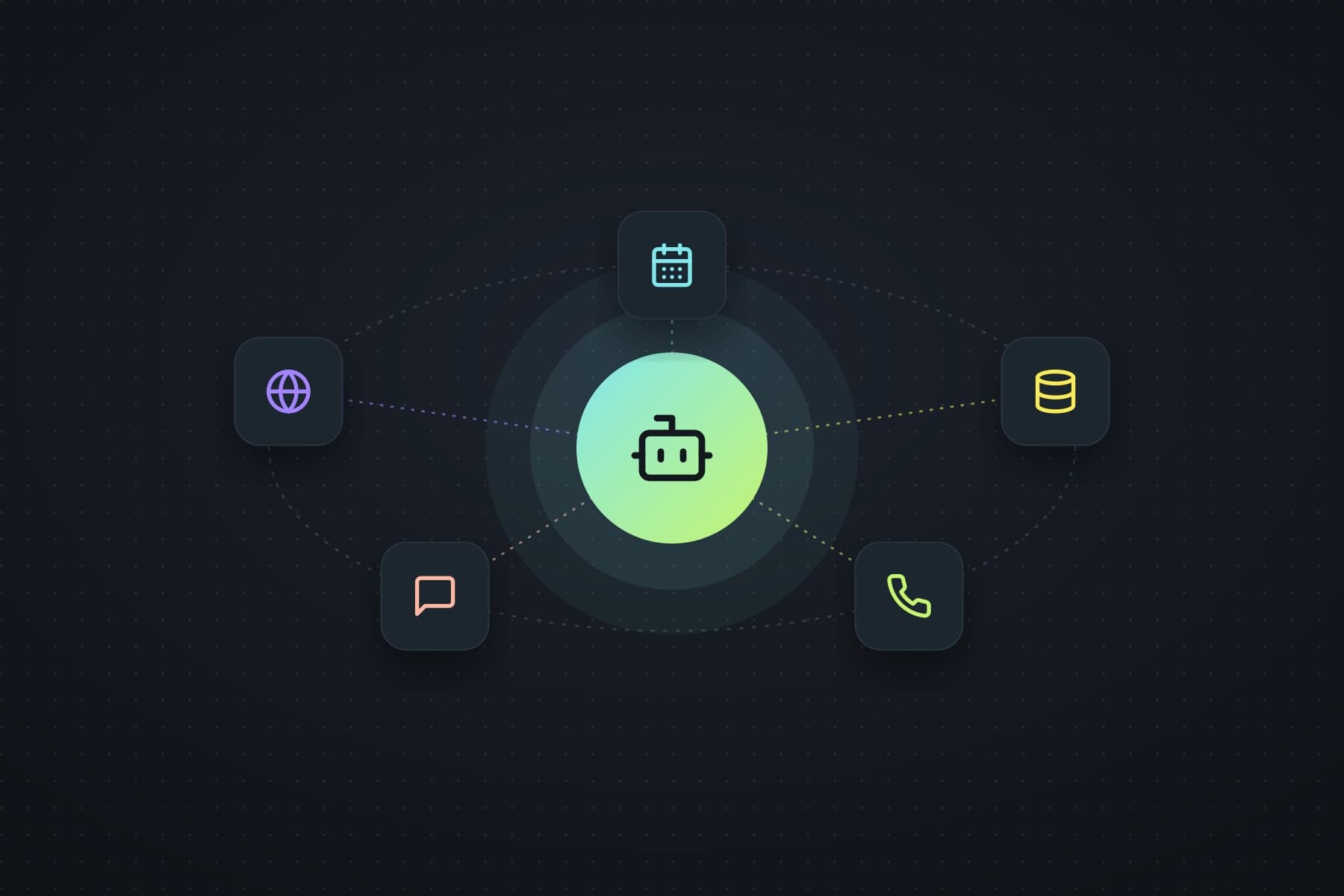
In short: An AI agent is a software system that completes a task on its own. It understands a request, uses a language model to decide on the next step, uses tools such as a calendar or CRM, and checks the result until the task is done or it hands over to a person. A chatbot answers, an AI agent acts. In customer service, for example, it answers calls, responds to questions from your knowledge base and books appointments.
We revised this post in October 2026. The previous version gave a starting price of a few cents per chat for the chat agent. In fact it starts at €40 for 100 chat conversations, and the voice agent at €75 for 250 minutes. We also removed a response-time claim, an alleged blind test and two channels that EchoCall does not offer. WhatsApp is currently not part of what you set up yourself in the EchoHub. Today the EchoCall chat agent runs on your website, with handover to your team.
What is an AI agent? The definition
There is no binding definition, but the major vendors and research labs describe the same core.
- OpenAI: agents are systems that independently accomplish tasks on a user's behalf [1].
- IBM: an AI agent is a system that autonomously performs tasks by designing workflows with available tools [2].
- Anthropic: agents are typically just language models using tools based on feedback from their environment, in a loop [3].
Three features come up everywhere. An AI agent has a goal, namely the task someone gives it. It has tools to gather information and take actions. And it controls which step comes next. OpenAI draws an explicit line: applications that integrate a language model but do not let it control the workflow are not agents. The guide names simple chatbots and single-turn language models as examples [1].
What does the law say?
The EU AI Act does not use the term AI agent. In Article 3(1) it defines an AI system: a machine-based system that is designed to operate with varying levels of autonomy, that may exhibit adaptiveness after deployment, and that infers from the input it receives how to generate outputs such as predictions, content, recommendations or decisions that can influence physical or virtual environments [4]. In our understanding, an AI agent in customer service falls under this definition. The disclosure duty in Article 50 therefore applies to it as well, more on that below.
How does an AI agent work?
OpenAI breaks an agent down into three core components [1]:
- The model. A language model understands the request, plans and decides.
- The tools. Interfaces to other systems that the agent uses to retrieve data or change something, such as adding an appointment or opening a ticket.
- The instructions. Clear rules on what the agent is responsible for, how it behaves and where its limits are.
In customer service, a knowledge base is almost always added. The technique behind it is called retrieval-augmented generation, RAG for short. It connects the language model to a searchable document collection [5]. For every question, the agent looks for matching passages in your material and writes the answer from them.
The loop of perceiving, deciding, acting and checking
An agent works in a loop:
- Perceive. The agent receives an input: a spoken sentence on the phone, a chat message or the result of a tool.
- Decide. The language model recognises the intent and plans the next step, based on the instructions, the knowledge base and the conversation so far.
- Act. The agent calls a tool or replies to the person.
- Check. It evaluates the result and decides whether the task is done, whether another step is needed or whether to hand over to a person.
Yao and colleagues described this principle in 2022 under the name ReAct: the language model generates reasoning traces and actions in an interleaved manner instead of answering everything in one go [6]. A classic chatbot, by contrast, stops at the first step. It answers, but it does not act.
On the phone and in chat
A voice agent runs three stages one after another. Speech recognition turns what is said into text. The language model decides what happens next. Speech synthesis turns the answer back into spoken language. At EchoCall, phone agents also have their own system tools: end the call, detect voicemail, send keypad tones, detect the caller's language and transfer to a phone number.
A chat agent does without speech recognition and synthesis, but the principle is the same. Since October 2026, visitors can also talk to the agent via microphone in the EchoCall chat widget. A notice card appears first, and the minutes come from the voice allowance.
AI agent vs. chatbot vs. AI assistant vs. RPA
| Criterion | Classic chatbot | AI assistant | RPA bot | AI agent |
|---|---|---|---|---|
| Understanding | fixed keywords and rules | free language | none, follows a script | free language with context |
| Who decides | the decision tree | the person using it | the script | the agent, within limits |
| Acting | only answers | delivers drafts and summaries | performs predefined clicks | picks the right tool itself |
| When things deviate | breaks off | asks the person | breaks off | adjusts the next step or hands over |
| Example | FAQ buttons on a website | draft of a reply email | transfer invoice data into the ERP | take a call, book an appointment, update the CRM |
RPA stands for robotic process automation. Such bots click their way through programs following a fixed script. That is fast and reliable as long as nothing changes. An AI agent is slower and less predictable, but it copes with requests nobody anticipated. Anthropic therefore advises always looking for the simplest solution and using agents where the number of steps required cannot be predicted [3].
Two posts go deeper into the comparison. AI Chat Agents vs. Traditional Chatbots: Differences, Costs and When a Rule-Based Bot Is Enough helps you decide for your website chat. AI Agents vs. Chatbots: What's the Difference? explains tools, planning and autonomy.
Where businesses use AI agents
AI agents deliver the most for requests that come up often, are phrased in free language and end with a clear action.
- Phone customer service: answering calls and questions, booking appointments, transferring to staff. More in the AI Voice Agents guide.
- Medical practices: appointment booking and recurring questions on the phone, see Automating Appointment Booking in Medical Practices.
- Trades businesses: taking on jobs and emergencies when nobody can get to the phone, see Answering the Phone in the Trades 2026.
- Estate agents: recording viewing requests and coordinating appointments, see Call Centre or AI for Real Estate Agents 2026.
- Website chat: product questions, order status and appointment requests, with handover to your team in the Live Inbox.
- Front desk on site: with EchoCall Presence, an AI avatar on a tablet at the counter talks to visitors, see AI Receptionist Kiosk 2026.
An example: moving an appointment by phone
A patient calls a practice and wants to move her appointment. This is how an AI agent handles the case:
- It answers and says in the very first sentence that an AI is speaking. At EchoCall, you write this sentence into the agent's first message yourself.
- It understands the request in free language, without a keypad menu.
- It asks for name and date of birth and finds the existing appointment in the calendar, for example in Google Calendar, Outlook or Cal.com.
- It checks free slots and suggests two alternatives.
- Once the patient agrees, it enters the new appointment, releases the old one and sends a confirmation by email if requested.
- If the patient asks about test results, it does not answer itself but transfers the call to the practice.
Step 6 is not a detail. OpenAI recommends planning for human intervention, especially after repeated failure and for high-risk actions [1].
Where the limits of an AI agent lie
A language model works with probabilities. The taskforce of the European data protection authorities notes that such models may produce biased or made-up outputs that users nevertheless take as accurate [7]. A well-maintained knowledge base lowers this risk but does not rule it out.
There is a legal limit too. Under Article 22 GDPR, people have the right in principle not to be subject to a decision based solely on automated processing that produces legal effects concerning them or similarly significantly affects them. The German data protection conference points this out explicitly in its guidance on AI [8]. An AI agent may book appointments and answer questions. A person should make the final call on an application or a cancellation.
And not every task needs an agent. OpenAI advises checking first whether the use case clearly meets the criteria. Otherwise, a deterministic solution may suffice [1].
How much does an AI agent cost?
You will find very different pricing models on the market: per call minute, per chat conversation, per user, or a custom build with costs for the model, hosting and development. Always compare the price per resolved request, not the list price.
At EchoCall you pay for packages, net per month [9]:
| Product | Package | Price |
|---|---|---|
| Voice agent (phone and browser) | 250 minutes | €75 |
| Voice agent | 500 minutes | €150 |
| Voice agent | 1,500 minutes | €450 |
| Voice agent | 5,000 minutes and more | €1,500 |
| Chat agent (website widget) | 100 conversations | €40 |
| Chat agent | 300 conversations | €120 |
| Chat agent | 1,000 conversations | €400 |
| Chat agent | 5,000 conversations and more | €1,000 |
For the voice agent, that is €0.30 per minute, and there is no setup fee. Phone numbers and telephony costs are not included in the package prices.
A worked example with assumptions, not measurements: if a typical call lasts three minutes, 250 minutes cover just over 80 calls. At €75, that is about 90 cents per call. Whether that pays off depends on what a missed call, or one answered by hand, costs you. Use the ROI calculator to plug in your own figures.
To try it out there is a trial: 30 voice minutes and 30 chat conversations for 14 days, and the credit card is verified with €1. The live demo is even quicker: you enter your website address, and in about 20 seconds an agent is built from your public pages that you can call or write to in the browser, without signing up.
Frequently asked questions
What is an AI agent, in simple terms?
An AI agent is a program that gets a task done for you instead of only answering questions. It understands what someone wants, decides on the necessary steps itself and uses other systems to take them, such as a calendar. If it gets stuck, it hands over to a person.
Is an AI agent the same as a chatbot?
No. A classic chatbot answers questions according to fixed rules or scripts. An AI agent understands free language, makes its own decisions about the next step and carries out actions in connected systems, such as booking an appointment or adding an entry to the CRM.
What is the difference between an AI agent and an AI assistant?
An AI assistant supports a person who makes the decision and uses the result, for example when drafting an email. An AI agent completes a task itself, such as moving an appointment for a caller, and stays within defined limits while doing so. The terms are not standardised.
Do you need programming skills to use an AI agent?
Not with EchoCall. You set up the knowledge base, tools and handover in the EchoHub. The chat agent goes onto your website with a script snippet or the WordPress plugin. If you want to connect your own software, you use the REST API.
Can an AI agent be used in compliance with the GDPR?
Yes, if the conditions are right. They include a data processing agreement with the provider, a check whether inputs are used to train models, and as little personal data as possible [8]. EchoCall runs the platform in IONOS data centres in Frankfurt and Karlsruhe and offers a zero-PII mode in the EchoHub.
Does an AI agent have to identify itself as AI?
Yes. Under Article 50(1) of the AI Act, people must be informed that they are interacting with an AI [4]. In the EchoCall chat widget, the notice appears automatically. For phone agents, you write it into the first message yourself. The editor shows an info box for this, and the help centre has example sentences.
Sources
- OpenAI, A practical guide to building agents: cdn.openai.com
- IBM, What Are AI Agents?: ibm.com
- Anthropic, Building effective agents (19 December 2024): anthropic.com
- Regulation (EU) 2024/1689 (AI Act), Article 3(1) and Article 50: eur-lex.europa.eu
- Lewis et al., Retrieval-Augmented Generation for Knowledge-Intensive NLP Tasks (2020): arxiv.org
- Yao et al., ReAct: Synergizing Reasoning and Acting in Language Models (2022): arxiv.org
- European Data Protection Board, Report of the work undertaken by the ChatGPT Taskforce (May 2024): edpb.europa.eu
- Datenschutzkonferenz (German data protection conference), Orientierungshilfe Künstliche Intelligenz und Datenschutz, version 1.0 (6 May 2024), in German: datenschutzkonferenz-online.de
- EchoCall pricing: echocall.de/en/pricing
All links were checked on 6 October 2026. This post is not legal advice.